Abstract Geometric Pattern Pack: A Practical Resource for Design-Forward Projects
Designers, marketers, and content creators often face the same recurring challenge: finding high-quality, versatile pattern assets that integrate seamlessly into professional workflows—without requiring custom illustration time or licensing complications. The Abstract Geometric Pattern Pack addresses this need directly. It’s not a subscription service, a generative tool, or a marketplace with variable quality—it’s a curated, one-time digital download of 20 original abstract geometric patterns, delivered in two reliable formats: EPS10 (vector) and high-resolution JPEG (approx. 2000px × 2000px).
What You Actually Get—and Why Format Matters
The pack includes no physical item—only digital files. That means immediate access and zero shipping delays, but also requires users to confirm compatibility with their software before purchase. The EPS10 format ensures scalability without pixelation, making it suitable for large-format prints like wall graphics, packaging mockups, or presentation backdrops. The JPEG version serves well for web use, social media banners, or quick prototyping in tools like Figma or Canva—provided the resolution aligns with your output needs.
Unlike some pattern collections that rely on raster-only assets or outdated vector standards, EPS10 remains widely supported across Adobe Illustrator, CorelDRAW, Affinity Designer, and even newer vector editors via import. That backward and forward compatibility adds tangible reliability—especially for freelancers juggling multiple clients with varying software constraints.
Design Integrity and Visual Cohesion
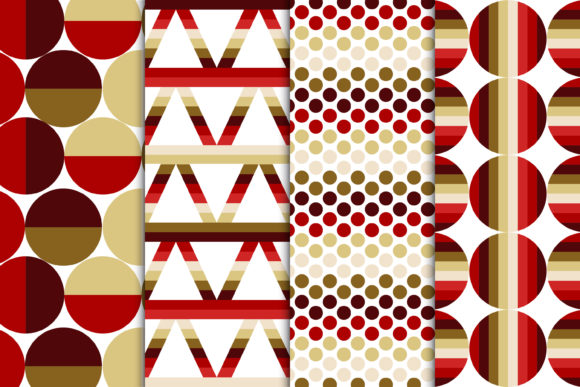
The patterns avoid overused tropes: no generic chevrons, predictable tessellations, or dated gradients. Instead, they feature intentional asymmetry, layered line weights, subtle opacity variations, and balanced negative space—traits that lend themselves to modern branding, editorial layouts, and UI surface treatments. Each pattern maintains internal consistency in stroke rhythm and scale relationships, which helps when applying them across multi-page documents or brand guidelines.
That cohesion doesn’t mean uniformity. Within the set, you’ll find options ranging from tightly interlocked angular motifs to looser, gestural arrangements—some optimized for subtle background use, others bold enough to anchor a hero section. This range supports both restraint and emphasis, depending on context.
Real-World Usability Across Common Scenarios
A freelance graphic designer recently used three patterns from the Abstract Geometric Pattern Pack to unify a client’s rebrand: one as a textured overlay on photography for their website banner, another scaled down as a repeatable background for email newsletter headers, and a third reversed in color and enlarged for a trade show booth backdrop. No recoloring was needed—the base palette worked across light and dark modes, and the vector file scaled cleanly up to 3 meters wide.
Similarly, an educator developing online course materials applied a low-opacity version of one pattern as a non-distracting background layer behind text-heavy slides—improving visual hierarchy without compromising readability. In both cases, the asset functioned as intended because it was designed with real application constraints in mind: contrast ratios, tiling behavior, and export flexibility.
Who Benefits Most—and Where It Fits (or Doesn’t)
The Abstract Geometric Pattern Pack suits professionals who value efficiency without sacrificing aesthetic control. That includes:
- Small business owners creating branded merchandise, social media templates, or pitch decks—especially those without in-house design support;
- Bloggers and publishers seeking distinctive visual identity elements beyond stock photos or default themes;
- UI/UX designers needing scalable, neutral-yet-interesting textures for dashboard surfaces or app onboarding screens;
- Educators and trainers building slide decks, handouts, or learning modules where visual consistency reinforces credibility;
- Print designers preparing packaging mockups, stationery suites, or exhibition graphics where vector fidelity is non-negotiable.
It’s less suited for users needing photorealistic textures, animated patterns, or AI-generated variants—nor does it include editable source files (e.g., layered PSDs or Illustrator layers with named objects). If your workflow depends on granular per-element adjustments—like isolating individual shapes to recolor or animate—the pack won’t accommodate that level of modification.
Quality, Consistency, and Long-Term Value
Each pattern was built at native size in vector, then exported with clean paths and minimal anchor points—avoiding bloated files or rendering glitches in older software versions. Testing across Illustrator CC 2019 through 2024 confirmed consistent rendering, even with complex transparency stacks. The JPEG exports maintain sharp edges and accurate color representation under sRGB, verified using soft-proofing tools.
Consistency extends beyond technical execution: all patterns share a similar baseline density and visual weight. That makes mixing them within a single project feasible—unlike some packs where one pattern dominates while another disappears at small scales. This predictability reduces trial-and-error during layout phases, saving time on revisions.
Long-term value hinges on reuse potential. Because these are abstract—not trend-dependent illustrations—they age well. A pattern used in a 2022 annual report remains appropriate for a 2025 product launch, provided the brand’s visual language hasn’t shifted toward maximalism or ultra-minimalism. That durability matters for teams maintaining cohesive assets across years—not just campaigns.
Practical Considerations Before Downloading
Before acquiring the Abstract Geometric Pattern Pack, verify your software supports EPS10 natively or via reliable import plugins. While most current design applications do, some web-based editors (e.g., certain Canva Pro features) only accept SVG or PNG—meaning you’d need to convert the EPS first, potentially losing editability.
Also consider how you intend to apply the patterns. If you’re working primarily in responsive web environments, test the JPEG version at multiple breakpoints—some patterns may require manual tiling or CSS background-size adjustments to avoid awkward repetition on narrow viewports. For print, always embed the EPS directly rather than placing a JPEG version, to preserve crispness.
Finally, assess whether 20 patterns meets your scope. It’s enough for focused projects—say, a full brand rollout across digital and print touchpoints—but may feel limited for agencies managing dozens of concurrent clients with distinct visual directions. In those cases, pairing this pack with one or two complementary resources (e.g., a monochrome icon set or a typographic texture pack) often yields stronger overall results than stretching a single collection too far.
A Balanced Tool, Not a Magic Solution
The Abstract Geometric Pattern Pack doesn’t replace thoughtful design decisions—it supports them. Its strength lies in reducing friction: skipping the search for royalty-free assets, avoiding licensing ambiguities, and eliminating the need to build patterns from scratch when deadlines loom. It delivers what it promises—clean, contemporary, technically sound geometric patterns—in formats that work across common professional pipelines.
For creators who prioritize reliability over novelty, and practical integration over flashy features, it earns its place as a quietly useful component in a well-organized digital toolkit. Used deliberately—not as decorative filler—it contributes to work that feels considered, consistent, and visually grounded.